
Partitioned primary index or PPI is used for physically splitting the table into a series of subtables. With the proper use of Partition primary Index we can save queries from time consuming full table scan. Instead of scanning full table, only one particular partition is accessed.
Follow the example below to get the insight of PPI –
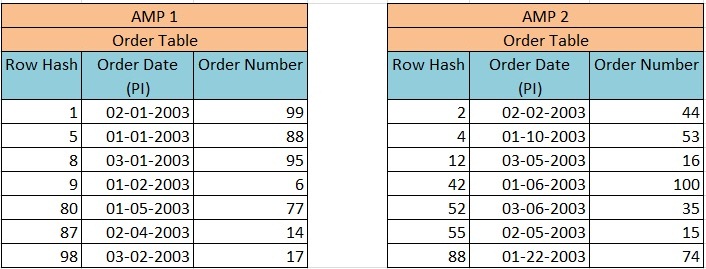
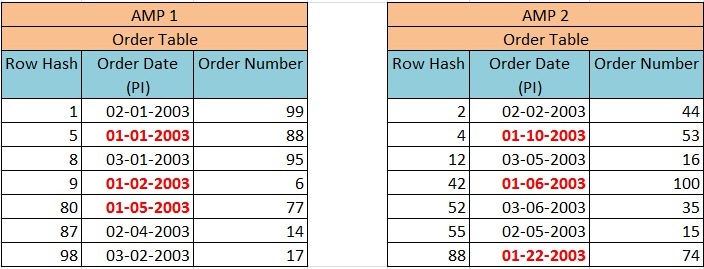
We have an order table (ORDER_TABLE) having two columns – Order_Date and Order_Number, in which PI is defined on Order_Date. The primary Index (Order_Date) was hashed and rows were distributed to the proper AMP based on Row Hash Value then sorted by the Row ID. The distribution of rows will take place as explained in the image below –
Now when we execute Query –
Select * from Order_Table where Order_Date between 1-1-2003 and 1-31-2003;
This query will result in a full table scan despite of Order_Date being PI.
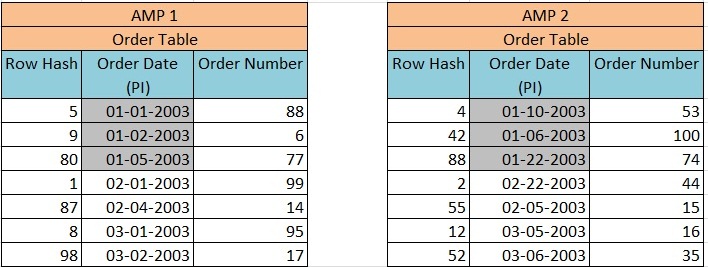
Now we have defined PPI on the column Order_date. The primary Index (Order_Date) was hashed and rows were distributed to the proper AMP based on Row Hash Value then sorted by the Order_Date and not by Row ID. The distribution of rows will take place as explained in the image below –
Now when we execute Query –
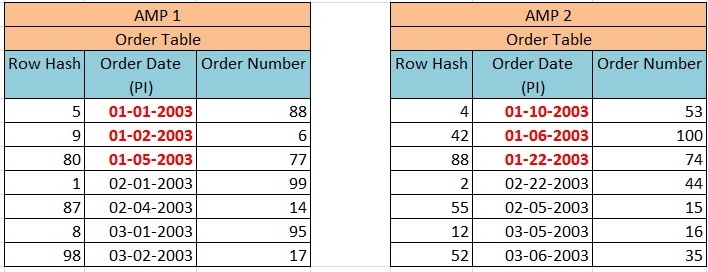
Select * from Order_Table where Order_Date between 1-1-2003 and 1-31-2003;
This query will not result in a full table scan because all the January orders are kept together in their partition.
Partitions are usually defined based on Range or Case as follows.
Partition by CASE
CREATE TABLE ORDER_Table (
ORDER_ID integer NOT NULL,
CUST_ID integer NOT NULL,
ORDER_DATE date ,
ORDER_AMOUNT integer
)
PRIMARY INDEX (CUST_ID)
PARTITION BY case_n (
ORDER_AMOUNT < 10000 ,
ORDER_AMOUNT < 20000 ,
ORDER_AMOUNT < 30000,
NO CASE OR UNKNOWN ) ;
Partition by RANGE
CREATE TABLE ORDER_Table
(
ORDER_ID integer NOT NULL,
CUST_ID integer NOT NULL,
ORDER_DATE date ,
ORDER_AMOUNT integer
)
PRIMARY INDEX (CUST_ID)
PARTITION BY range_n (
ORDER_DATE BETWEEN date ‘2012-01-01’ and ‘2012-12-31’ Each interval ‘1’ Month,
NO range OR UNKNOWN ) ;
If we use NO RANGE or NO CASE – then all values not in this range will be in a single partition.
If we specify UNKNOWN, then all null values will be placed in this partition
To know about the advantage and disadvantage of PPI please go to link below –




85 comments
Skip to comment form
I’ll right away grab your rss feed as I can’t find your e-mail subscription hyperlink or newsletter service. Do you’ve any? Kindly let me know so that I may subscribe. Thanks.
Thank you for the good writeup. It in fact was a amusement account it. Look advanced to more added agreeable from you! However, how could we communicate?
Hi, I log on to your new stuff daily. Your story-telling style is witty, keep doing what you’re doing!
I simply could not leave your website prior to suggesting that I actually enjoyed the standard information an individual supply in your visitors? Is gonna be again incessantly in order to check out new posts
I’ll right away snatch your rss as I can’t in finding your email subscription hyperlink or newsletter service. Do you’ve any? Please permit me understand so that I may subscribe. Thanks.
Hello! I’ve been reading your site for some time now and finally got the courage to go ahead and give you a shout out from Dallas Tx! Just wanted to mention keep up the fantastic work!
I will immediately seize your rss as I can’t in finding your email subscription link or e-newsletter service. Do you’ve any? Kindly let me know so that I may just subscribe. Thanks.
I visited multiple sites except the audio feature for audio songs existing at this website is truly marvelous.
Ahaa, its good conversation regarding this post here at this webpage, I have read all that, so now me also commenting here.
I’ll immediately seize your rss as I can not to find your e-mail subscription hyperlink or newsletter service. Do you have any? Please permit me recognise in order that I may subscribe. Thanks.
https://shorturl.fm/4lnX3
I simply could not leave your site prior to suggesting that I extremely enjoyed the usual information a person provide on your guests? Is going to be again incessantly to investigate cross-check new posts
https://shorturl.fm/4DwiM
I am sure this article has touched all the internet users, its really really pleasant paragraph on building up new website.
https://shorturl.fm/gaUcW
This excellent website really has all of the information and facts I needed concerning this subject and didn’t know who to ask.
Tigrinhobet, meu camarada! Achei um site show de bola pra dar uns palpites. Fácil de usar e as odds são daquelas que enchem o bolso! Vale a pena conferir tigrinhobet.
https://shorturl.fm/B7KNg
https://shorturl.fm/eO1Zo
https://shorturl.fm/jii9G
Interesting read! Understanding player behavior & RTP (like with nustargame link) is key to solid poker strategy. Variance is real, but informed decisions matter most. Good analysis!
https://shorturl.fm/4baQ4
https://shorturl.fm/cU5kx
Been playing at ph123casino for a bit now. Site’s pretty smooth, and I’ve actually had some decent luck. Check it out ph123casino. You might get lucky too!
Great resource for finding AI tools! As someone always on the hunt for efficiency, platforms like AI Consulting Assistant save time and streamline decision-making.
https://shorturl.fm/TXZxI
Just saw phplus pop up, anyone know anything about it? Is it worth a visit? I’m always on the lookout for a new place to play. Let me know your thoughts! Here’s the link: phplus
https://shorturl.fm/o2JoB
https://shorturl.fm/GWosv
https://shorturl.fm/03tQp
https://shorturl.fm/OaBbe
https://shorturl.fm/hHUE4
https://shorturl.fm/p68Gh
https://shorturl.fm/TLh2O
https://shorturl.fm/jQP61
https://shorturl.fm/vusXp
https://shorturl.fm/Jz8Ts
https://shorturl.fm/JXAph
https://shorturl.fm/C3Rwq
https://shorturl.fm/4ZlWf
https://shorturl.fm/V7NBN
https://shorturl.fm/Qw074
https://shorturl.fm/93SK5
https://shorturl.fm/prXhF
https://shorturl.fm/DgwgK
https://shorturl.fm/VvYSA
https://shorturl.fm/6hQjz
https://shorturl.fm/vOEnp
https://shorturl.fm/B5954
https://shorturl.fm/pov54
Hi,
The explanatin is good but need to understand how the data is been retrieved while quering on PPI?
Will it exactly query only that partition in AMP instead of having so many number of partitins in AMP?
Author
Data retrieval process remains same with the exception of an additional check on partition number. If you are using PPI column in where clause then with the help of binary search Teradata will query exact partition, but in case no PPI column is being used in where clause then it needs to scan all the rows (in respective AMP) to find the matching row. This is trade off of using PPI because all queries without PPI column face all rows scan (in single AMP).
Hope it helps !!!
Thanks..one more question what happens if i define PPI columns other than PI column in that table.How the data is being retrieved.will the performamce increase or decrease by the above method.??
Dear admin ,
thanks for share Wonderfull blog
Thanks regards
Vijay Jadoun
Thank you Sir.
What is the process to change the existing table to PPI table and will there be any change in row distribution after conversion into Partioned primary index?
Sir can you please kindly explain multiload , the way u have explained fastload?
fastload explanation was really helpful..
Regards
How many amp operation is PPI?
Author
can be any number of AMP depending on your query. but not full table scan if you are using PPI columns in where clause
Range bases query on NUSI column ALWAYS do Full Table Scan OR it may utilize index?
simply superb explanation.
Information is very clear and simple…good work admin/..all the best for your future works
will there be an impact while loading huge data into tables like performance increase/decrease
Author
yes definitely.
if data is huge and your table is defined as SET table, then teradata needs to check uniqueness of each new row inserted. Similar check is required for Unique columns, UPI and USI as well.
This is just one example where your performance can be degraded because of huge number of rows.
its useful to me
gud
Why it is called partition primary index ? if we can do PPI on any column no matter its PI or not .
I did not get this. So taking your last example. suppose cust_id is the primary index (NUPI) and you did the partitioning based on case (order_amount). Now i fire query like this:
sel * from order table where order_amount between 5000 and 15000;
what does it mean ? we are not quering on the PI (cust_id) at all ! this will result into FTS still..right.
Also, why is it called PPI if the PI is cust_id and partitioning is done on ‘order_amount’ ? Thanks 🙂
Author
if order amount is defined as PPI, then optimizer will go for dynamic partition elimination step and pick only those partition which falls into the range specified in WHERE clause. Thus it will not be a FTS operation.
Hi,
Very nice explanation. Finally understood PPI.
Thanks a lot!
How do I actually view infromation about the partitions? Info like amount of data in each partition, # of rows, date loaded, those kind of items?
Author
you can write SQL queries to achieve this result. I don’t think there is any teradata tool available for this.
Hi Admin,
if we didnt mention NO RANGE OR NO CASE or UNKNOWN, what will happen to the records not falling in the range/case?
Thanks.
Hi,
The article is really good.. 🙂
One concern,
In the example,since jan data is avilable in both the amp’s it would still require a full table scan right?
No, because each AMP processes only his own part of the table, especially only his part of the partition of the table..
Good explanation
Really superb. Very Simple explanation
Finally i undeerstood PPI.
Thanks Admin.
Good One.
good explaination.. could have explained about Each interval ‘1’ Month,
I never understood PPI but after reading ur article my doubt is clear.
I missed ur website all these days 🙁 .. Really helpful …keep posting .
Author
Hi Veera,
What do you mean by missed it ? … are you facing some server downtime for my website ?
Next time please let me know in case you are facing this issue on my site 🙂
Very Well explained 🙂
Thanks for sharing this info.
Author
Thanks 🙂
well explained..
why it is called parition primary index ?
if we can do PPI on any column no matters its PI or not .