
The biggest strength of the Teradata is the parallelism. So the architecture of the Teradata is designed in such way to keep this strength in mind. Teradata is unique from any other database because of its unique architecture only.
The main components of Teradata architecture is PE (Parsing Engine), AMP (Access Module Processor) and BYNET . We look into these components in details after looking the logical view of the architecture.
The logical view of Teradata architecture is given below –
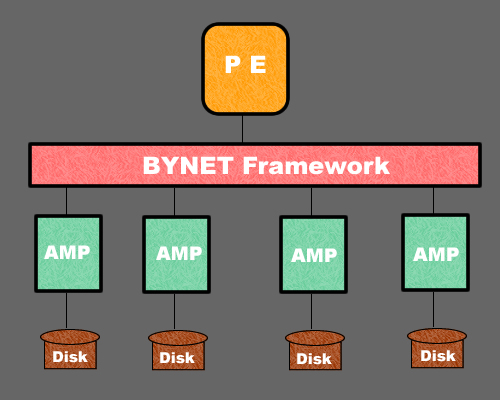
Parsing Engine (PE) – Whenever a user login to Teradata it actually connect to Parsing Engine (PE). When a user submits a query, then the PE takes action, it creates a plan and instruct AMPs what to do in order to get the result from the query. The PE knows all, it knows how many AMPs are connected to Teradata system, how many rows are in the table and what is the best possible plan to execute the query. This is why the PE is also called as the ‘OPTIMIZER’.
Beside making a perfect plan for query execution PE also make a check on the access right of the user that weather the user has the privilege to execute the query or not. In this way PE also perform security feature on the users.
Access Module Processor (AMP) – Each AMP attached to the Teradata system listens to the PE via the BYNET for instructions. Each AMP is connected to its own disk and has the privilege to read or write the data to its disk. The AMP can be best considered as the computer processor with its own disk attached to it. Whenever it receives the instructions from the PE it fetches the data from its disk and sends it to back to PE through BYNET. Each AMP is allowed to read and write in its own disk ONLY. This is known as the ‘SHARED NOTHING ARCHITECTURE’. Teradata spreads the rows of the table evenly across all the AMPs, when PE asks for data all AMPs work simultaneously and read the records from its own DISK. Hence a query will be as slow as the slowest AMP in the system. This is known as parallelism.
BYNET – The BYNET is the communication channel between PE and AMP. It ensures that the communication between PE and AMP is correct and on right track. In Teradata system there are always two BYNET system. They are called as ‘BYNET 0’ and ‘BYNET 1’. But we refer them as a single BYNET system. The reason two BYNET exist on a Teradata system is that –
1) If one BYNET fails, the second BYNET takes over it place.
2) Two BYNET improve the performance of the system, the PE and AMP can talk to each other over both BYNET which fasten the communication.
Short summary –
- The PE checks the syntax of the query, check the user security rights
- Then PE come up with the best optimized plan for the execution of the query
- The PE passes this plan through BYNET to AMPs.
- The AMPs follow the plan and retrieve the data from its DISK.
- Then AMPs passes the data to PE through BYNET.
- The PE then passes the data to the user.
I have also identified few E books which is immensely useful for Teradata Certification Preparation. Please have a look and if you are seriously preparing for TD certifications then don’t hesitate to purchase it.(Hover the mouse on the below image to get more information about the book)
 |
 |
 |





98 comments
Skip to comment form
GcygbkXNJPsOCaSBpwhQy
Yo, just checked out 32wingame. Pretty slick site, man! Definitely giving it a look. Check it out yourself 32wingame.
Sinagphcom? Not bad, not bad! The site design is clean and they got the usual stuff. Might be worth a spin if you’re bored. Hit them up at sinagphcom
Found this keo88bet site. Looks interesting, but I’m always skeptical. Any thoughts? Any experiences to share? Here is the link: keo88bet.
hi all,
Let me know what actually the bynet do? & who integrates the data from these amps&where the metadata stores about these amps(i.e what data that particular amp
stores.
thanks
Sorry, the Bynet is proprietary to Teradata. If you want most info on the Bynet, search their public documentation.
Hi Admin
Very nice and crystal clear description for beginners.
Would be more helpful if i can get some idea on topics on teradata like fallback clusters,cliques, Hashing Algorythims and journals.
Author
please refer our free tutorial here –http://www.teradatatech.com/?page_id=587
you’ll get most of the topics listed
hi
currently i am working as testing engineer using informatica, oracle. i would like learn teradata for career growth. please suggest me what way to learn basics in teradata. is this relevant t to oracle sql commands or not.
please suggest me.
thanks
sri
hi admin
can you tell me that how many disk can be held by one amp?
Each AMP has associated with one disk…
what is differanc between teradata 12 and td 13
what is differanc between teradata 12 and 13
CTRL+p and save the pages
What is the maximum limit of AMP connected to BYNET?
Author
Each BYNET can support maximum 512 nodes.
In Each Node we can run maximum up to 16384 VPROCS (AMP, PE, Gateways etc).
what is node here in this case?
Very nice explanation for each component. Should share some more infirmation about Teradata.
Author
Hi All,
We have started a new special online teradata training batch for developers and DBA profile. For those who are interested to learn teradata can register in this batch. Fees is quite less when you compare it with other batches and biggest advantage is that its a instructor led training batch so you can ask any doubt in the training itself. Also we’ll be covering latest version of Teradata i.e. Teradata 14.10
Please check following link for more details about this batch –
http://www.onlineteradatatraining.com/?page_id=96
Limited Seats. So try to register ASAP.
If each PE supports up to 120 sessions and each session can run 16 requests in parallel and each AMP can run 80 tasks in parallel, does this mean that we need minimum 24 AMPs ((120*16)/80)???
Hi Admin,
Could you please reply to this question i am also intrested in knowing the answer of this
No of AMPS used depends on the type of request submitted and type of index used in the query. A request can be a single AMP,group AMP or an all AMP one based on whethere we are using a PI/SI or no index.
No of AWT’s(AMP worker tasks) used depends on how many steps into which PE/Optimizer disects our query into.
At most 62 AWT’s can run in an AMP to do user related works, Rest 18 are reserved for internal work types.
At a single point of time a session can have only one active query(it can either be a single statement or a multi statement query). This single query is divided into multiple steps and sent to AMPS by PE, AMPS distribute these steps among AWT’s to do a portion of the work.
For understanding an AMP can be compared to a Process and an AWT can be compared to a Thread running under a Process.
i need to learn basics of teradata as i am using this in mainframe… can please any body guide me which materials or url shd i use
Shashank,
Same situation here, Even I use this with MF. Please feel free to contact me – sriv.shivam@outlook.com
I am using TD v12 with MF, in retail Project
this is best website ,good work guys.
keep it .
Awesome Explanation……………………………. Superr Guru
Thank you Sir! Your blog is very helpful, and the users too are intuitive because of which we get to learn new dimensions of a particular topic.
I have one question-
How is the number of AMPs , and size of each AMP decided?
Author
Number of AMP and size is decided at the time of configuration of teradata system. Usually it depends on the requirement of project.
Nice Explanation for teradata Architecture
very good explaination on TD for a novice.
Very informative…… Great work i must say..!!
Hi admin.
I wants to do teradata certification. please guide me
WAT A SITE I NEVER SEEN BEFORE BEST EXPLANATION KEEP IT
Good site
hi
good explanation…
I hav a doubt…
according to u…Execution will be slow as much as slowest amp but when one amp fails what happens to execution…
will it stop the entire execution..
Author
when an AMP fails then teradata data protection features comes in action like (hot standby node, cliques, down amp recovery journal).
in case these protections are not able to migrate the data of that failed AMP (highly impossible) then your execution will stop until you recover that AMP.
To further explain 2 points in case they are not clear:
1. AMP writes to its “local” disk.
2. In case, an AMP instance fails, a hot-standby can take over.
Seeing both points together raises a question that if AMP writes locally then how does its local data get replicated to another instance. The way they do it is to actually have a common storage array between both AMP instances. They use iSCSI based SAN here, I think. So, both are sharing this “local” disk array. In case, the primary instance fails, the hot-standby can always be started without any “data-lag”. Of course, with iSCSI SANs also, storage tier can be a SPOF.
It is correct that an AMP can perform I/O ops only on the VDISK/LUNS assigned to it.
AMPS cannot read/write to VDISKS assigned to other AMPS.
Coming to Hot Standby Nodes(HSN), They are protection mechanism for NODE failures, they can not protect against AMP failures.
In case of a Node failure, AMPS get redistributed among other nodes or HSN(if present). For the migrated AMPS to perform operations on their VDISKS, Group of Teradata nodes(Cliques) are configured to access Disk Arrays of other nodes within the group like mentioned in previous comments. So, even if a node fails VPROCS migrated to other Nodes or HSN still can access the VDISKS in the Disk Array configured to the failed node.
In case of AMP failures, The data of that particular AMP is not accessible which means full table scans and index operations involving failed AMP are not possible. Index accesses on healthy AMPS can still be performed.
To protect against AMP failures, we have Fallback mechanism which replicates an AMPS data on another AMP. So, In case of an AMP failure, data can still be accessed from the fallback AMP.
Hi Himabindu,
Can you please share your mail id :vvdrmca@gmaail.com
what is differanc between teradata 12 and 13
Hello Nitin,
Thanks for putting up extra efforts to share your knowledge with us. keep it up.
It is really good forum to learn TD concepts.
Thanks,
Gourav
Hi All,
This is Vivekanand, this is very use full to who want learn teradata very quickly from basics to high level but it is very difficult to copy the data.Can any one give how to copy the data from this website.
Thanks,
Vivekanand kola
Author
Hi Vivekanand,
Thanks for your comment.
Actually copying content from this site is banned to maintain the originality of content.
Hope you understand 🙂
Admin,
We should not live in visual reallity . The basic concept for which Internet is created is sharing. I don’t understand when admin says that you can read from here but can’t copy from here .
It’s just an CSS trick that disables right click which actually do not provide any security beacause any user who want data to copy will do ctrl + U and can copy easilly.
request to admin this security is of no use and actually it annoys while typing becuase you can’t correct your mistakes by doing right click.
Mukesh
just disable javascript in ur browser and reload the page. now u shud be able to copy it.
Hello all..i m new in teradata today is my 1st day in this organization..this site helps me alot to increase my knowledge level about this organization..i will make sure that i will be helpful for the company and will help the company by using my skills.. 😉
Hey every one,i m new in teradata n this site helps me alot to increase my knowledge level about this organization..
Hi admin,
this site is really helpfull! can i know about AWT? and in the concept of index why we go for secondary index when we already have primary index?
Author
secondary index is the alternate way to access data. To know more about SI please refer – http://www.teradatatech.com/?p=815
Hi All,
As I am new to TD and after reading the available input on this site really helped me to understand architecture of TD and how it actually works in real world in a very clear way to understand.
Actually I am an SQL server resource but I am learning TD for informatica but found it more interesting so pls guide how to start with it in a more simpleway to understand it.
Author
if anyone is interested in teradata training for development profile please have a look – http://www.onlineteradatatraining.com/
I find this site very helpful. All the concepts are presented in a simple manner.
I have a doubt – Out of Node, PE, BYNET,operating system,CPU and disks , which is a part of teradata open architecture?
Hi Anju,
This question i have faced in TD12 basics exam.. NODE is the part of teradata open architecture.
Author
thats correct 🙂
Hi,
First of all Many thanks for your useful post. I am new to teradata DB. Can you please post about SMP and MMP architectures.
Hi ,
The way you explained the architeture is really great and appricate.
Nice post for the beginners..
Author
Thanks 🙂
Hello,
Very nice post for the begineers..!!
I write to get the right suggestion from you on my move to Teradata DBA role from Oracle DBA role, I have 6 yrs of experience as an oracle core DBA. I’m very much confused to take the decision. can you let me know the market and the oppurtunities in teradata for a DBA role. ‘ll the move benefit my career?
Thanks
Pavan
Author
Hi,
Honestly speaking i don’t have much idea about ORACLE DBA market so can’t do the exact comparison between both these tech. But as far as TD DBA is concerned, there is huge requirements for DBA’s role, as you must be aware that TD is the emerging tech and most of the big shot clients are shifting towards huge data so its quite obvious that TD market is going strong day by day 🙂
All the best for your career in TD
Thanks
GOOD ONE
It’s very detailed and easily understandable for beginners
Thank You very much….
I am very much waiting for more posts from you/
good for a beginner
Author
thanks .. will very soon post on advanced Teradata architecture.
How do I find out how many AMPS my system has?
we can find the Amps in our system by using hash functions like
1)hash Amp
2)hash bucket
3)hash row.. etc
the query to find number of amps in our system is
SELECT HASH AMP( ) + 1;
here is a question that y we add 1. bcoz it shows one less than the actual amps. the reason is hash amp required the hash bucket value..
Regards
Rahul
Author
very well answer Rahul 🙂
just to add one small point …. the actual syntax of HASHAMP is –
HASHAMP (< hashbucket >)
so it will give you the AMP number of the particular hashbuket value.
but if you wont give any hashbuket value inside the bracket, then it will give the number of AMPs (less than 1) configured in the Teradata system.
very good explanation
thanks
how many amps will connect to bynet at at time?
Author
at the time all the AMPs in the teradata system are connected to BYNET.
very very clear explanation !!!!!!!!
Author
Thanks Chaitanya
Nice post.Thanks for sharing this
Author
Thanks Suhasini …
Nice explanation, Admin. Appreciated !!
Author
thanks…. 🙂
good one for TD freshers….
Author
Thanks … 🙂
Hi,
Am new to tera data.can u send me the docs of tera data to my mail id.my mail id is dilip.thokala@gmail.com.
Thanks & Regards
Dilip.T
Am new to teradata..This is very useful for me..Can you send the document for teradata? how to install & how to execute? Send this pdf of doc file to this mail id:renukadevi.ciet@gmail.com . Thanks in advance.
We nice and crystal clear explanation….!!
Dear Admin.. Topics mentioned are clearly expplained and very easy to quick grasp..please explain some more topics that are newly added to TD12 syllubus like (applaences,processing types etc,)
Expecting positive reponse
Thanks
PriyaSudheer
Author
will definitely try to post on TD 12 🙂
very clear explanation
Author
thanks .. 🙂
Really superb explanation!
Author
thanks 🙂
nice explanation
Neat. Clean, and I understood it. Thanks!
hai!
That was superb contribution regarding the architectural summary of teradata.
Thanks and regards
Prashant killada
Author
Thanks Prashant for the appreciation 🙂
hi
Author
hi
Hi Admin,
it is neat and clear explanation n understandable way.Thanks a lot 🙂
Author
hi Guys
check for the new set of TD Basic Sample Questions available on my site –
http://www.teradatatech.com/?p=325
Hi Admin,
I have one good question on to increasae Max number of sessions on TD 13.00
Here my Environment is TD database 13.00 and OS :Win -2003..
And We have 8 AMP’S and 1 PE on TD 13.00
Now my question is
We have a requirement of checking 200 simultaneous connection to Teradata.
Currently we have only able to make max 120 connections. (Because 1 PE =120 Sessions)
Now we need to increase the max no of sessions for Teradata DB. ?
Can you please tell em how to increase max no of sessions on TD ..
Is it possible to increase max no of sessions ?
Vasu,
It is not possible to raise the standard 120 session limit for a PE.
Your objective of being able to connect 200 sessions is still achievable if you can add up one more PE to the system. This can only be done with the help of Teradata PS support team as this involves downtime and re-configuration of the entire system.