
Interview Questions : SET 1

Question 1: Explain TPUMP (Teradata Parallel Data Pump) Utility in Teradata? Answer: TPUMP allows near real time updates from Transactional Systems into the Data Warehouse.It can perform Insert, Update and Delete operations or a combination from the same source. It can be used as an alternative to MLOAD for low volume batch maintenance of large …

Continue reading

Teradata Background Check

The Teradata database was originally designed in 1976, by TERADATA Corp. Nearly 25 years later, Teradata is still considered ahead of its time. In 1976, IBM, mainframes dominated the computer business. However the original founders of TD noticed that it took about 4½ years for IBM to produce a new mainframe. At the same time, …

Continue reading

How To Use Built-in Functions in Teradata?

First of all what are Built-in functions? These are functions which do not need any sort of arguments but still returns information about the system; user, date, time, session etc. Built-in functions are sometimes referred to as special registers. Mostly used with the SELECT statement. SELECT <Built-In Function> • ACCOUNT: – If you are wondering …

Continue reading

LIKE with ESCAPE sequence

LIKE is used in Teradata to match string against a set of pattern which a user required. There are two wild card characters used in LIKE and they are – ‘_’ and ‘%’. ‘_’ is used for single character search. ‘%’ is used for multiple character search. For e.g. 1) Suppose we want to search …

Continue reading

Components of Teradata

Teradata is made up of following components – Processor Chip – The processor is the BRAIN of the Teradata system. It is responsible for all the processing done by the system. All task are done according to the direction of the processor. Memory – The memory is known as the HAND of the Teradata system. …

Continue reading

Teradata Architecture

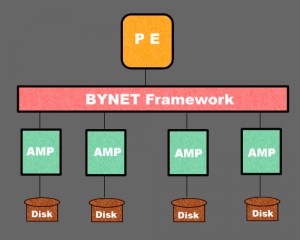
The biggest strength of the Teradata is the parallelism. So the architecture of the Teradata is designed in such way to keep this strength in mind. Teradata is unique from any other database because of its unique architecture only. The main components of Teradata architecture is PE (Parsing Engine), AMP (Access Module Processor) and BYNET …

Continue reading

How to get Case Sensitivity in Teradata

Teradata by default is case insensitive. Whatever value you compare in the WHERE clause it does not match the exact case of that value. So what if there is a scenario when you want to compare the value along with its specific case in the WHERE clause. Here come the CASESPECIFIC keyword for the rescue.Just …

Continue reading