

Author's posts
Feb 25
LIKE with ESCAPE sequence

LIKE is used in Teradata to match string against a set of pattern which a user required. There are two wild card characters used in LIKE and they are – ‘_’ and ‘%’. ‘_’ is used for single character search. ‘%’ is used for multiple character search. For e.g. 1) Suppose we want to search …
Feb 24
Components of Teradata
Teradata is made up of following components – Processor Chip – The processor is the BRAIN of the Teradata system. It is responsible for all the processing done by the system. All task are done according to the direction of the processor. Memory – The memory is known as the HAND of the Teradata system. …
Feb 24
Teradata Architecture
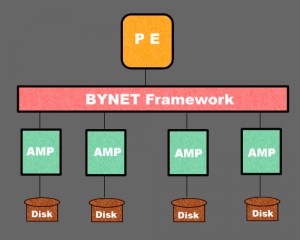
The biggest strength of the Teradata is the parallelism. So the architecture of the Teradata is designed in such way to keep this strength in mind. Teradata is unique from any other database because of its unique architecture only. The main components of Teradata architecture is PE (Parsing Engine), AMP (Access Module Processor) and BYNET …
Feb 23
How to get Case Sensitivity in Teradata

Teradata by default is case insensitive. Whatever value you compare in the WHERE clause it does not match the exact case of that value. So what if there is a scenario when you want to compare the value along with its specific case in the WHERE clause. Here come the CASESPECIFIC keyword for the rescue.Just …
Feb 23
Limitations of FAST LOAD

There are few limitations which we have on Fastload. These limitations are necessary for Fastload to load data with the lightning fast speed into tables. NO SECONDARY INDEXES ARE ALLOWED ON TARGET TABLE – Fastload can load tables only with primary indexes defined on it. If we have a secondary index on the table then …
Feb 21
Teradata Utilities : FASTLOAD – Part 1
Fastload is use to load vast amounts of data from flat files to empty tables of Teradata, with a lighting fast speed. Fast load is specially designed to load millions of rows in Teradata tables in a very less time as compared to other conventional methods. Fastload can run from either mainframe or network host. …


Sponsors of Teradata Tech